Research
Instrumentation
The physical instruments that make faint persistent signals recoverable at all.
The Field Instrumentation Group designs, builds, and maintains the instruments on which every measurement depends. Much of the equipment is built in-house; some of it exists nowhere else.
Detectors and arrays
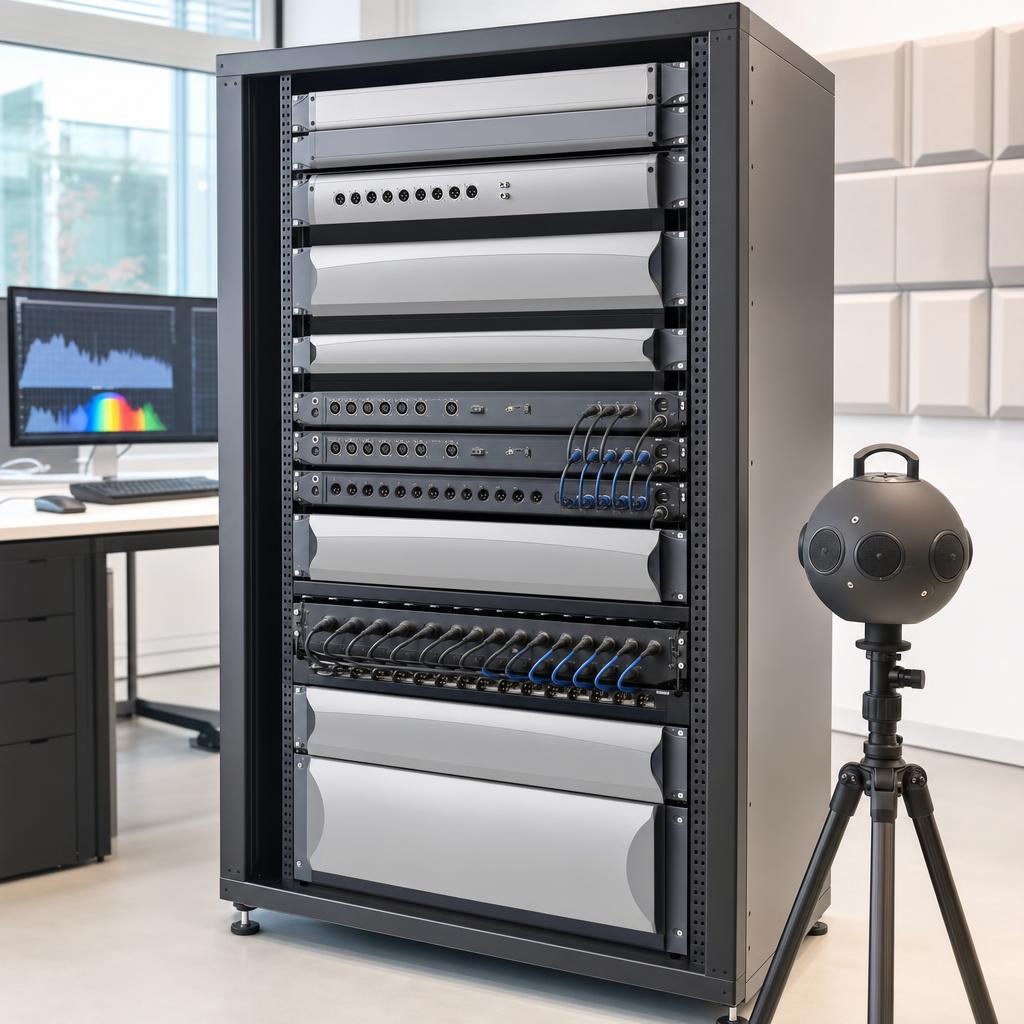
The Group is responsible for the antenna and hydrophone arrays at Calder Ridge, the remote field stations, the ground-resonance sensors, and the low-noise front ends that recover a signal from beneath the background. Its defining constraint is noise: every element, cable, and amplifier is chosen to add as little of its own as possible.
| Instrument | Band | Since |
|---|---|---|
| Antenna array | 3 Hz -- 30 kHz | 1971 |
| Hydrophone array | 1 Hz -- 2 kHz | 1960s |
| Ground-resonance network | sub-audible | 1961 |
| Remote stations | reduced suite | 1990s |
Calibration
An instrument that reads wrong the same way every time is telling you something -- but only if you know how it reads. The Group maintains the calibration standards that make the Laboratories' long baseline meaningful across decades, so that a detection in 1971 can be compared honestly against one today.
residual(t, f) = observed(t, f) - expected_environment(t, f) - instrument_baseline(t, f)

stable_residual = abs(mean(residual_window)) > 3.5 * noise_floor_sigma
                  AND phase_variance < station_limit
AND calibration_state == valid- Source
- Instrumentation methods training note
- As of
- 2026
- Method
- Simplified notation for public review of residual handling