Facilities
The Antenna Arrays
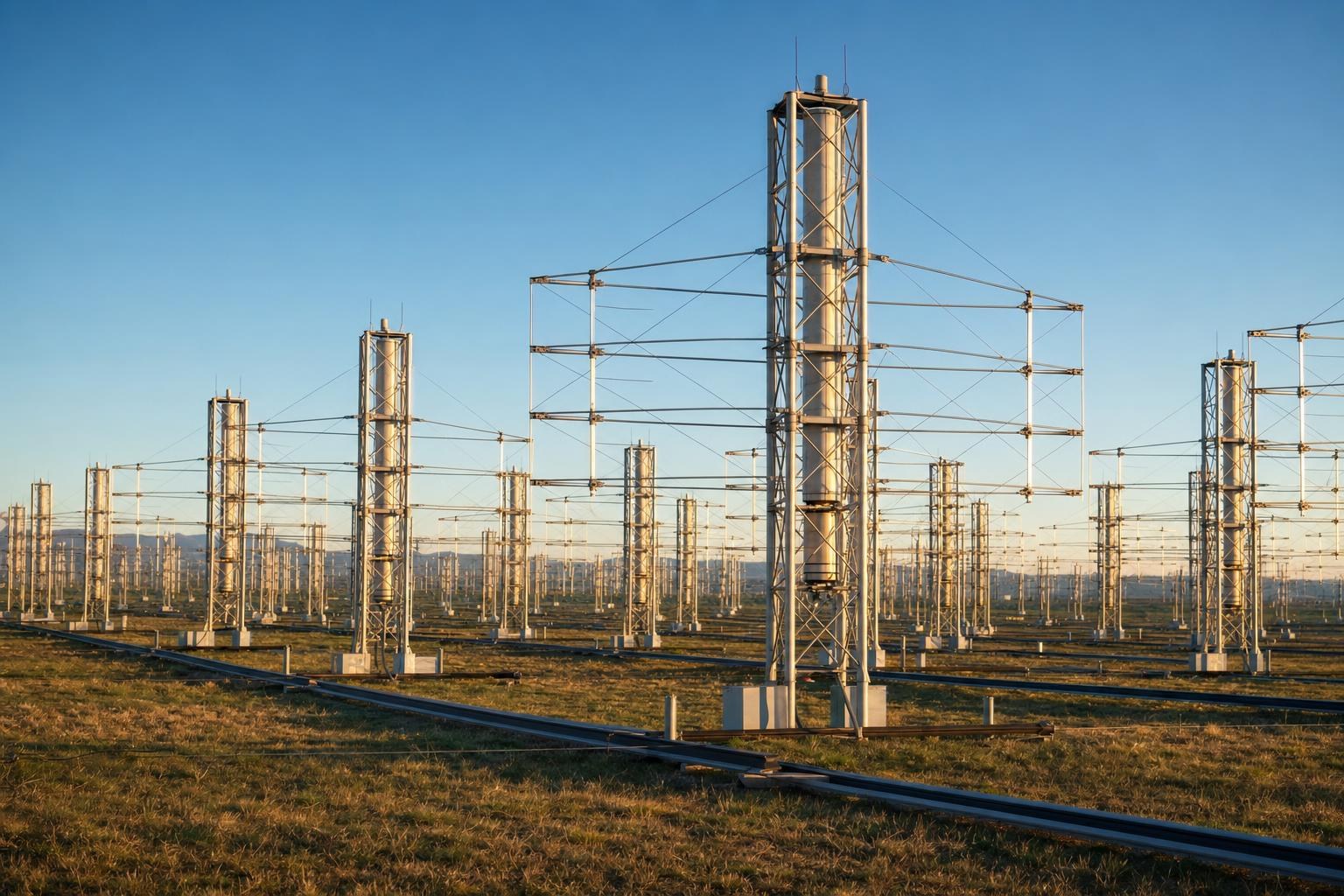
A distributed array of masts and low-noise receivers, tuned for narrow-band signals from the extremely-low through the very-low frequency bands.
The antenna array is the oldest continuously-operating instrument at Calder Ridge, and the one on which most of the Laboratories' celestial and aerial work depends. Its long baseline is what makes coincidence analysis possible: the same signal, recorded at points hundreds of metres apart, cannot be a single local fault.
Configuration
The array is a sparse, long-baseline arrangement of vertical and loop elements distributed across the tract, feeding low-noise receivers in shielded enclosures. Element spacing and orientation were chosen for sensitivity in the ELF through VLF range, where the Laboratories' longest-standing detections lie. The array has been extended and re-baselined several times since 1971; its current calibration standard dates to 2016.
| Parameter | Nominal value |
|---|---|
| Frequency range | ~3 Hz -- 30 kHz (ELF--VLF) |
| Baseline | up to ~1.6 km |
| Elements | vertical + loop, shielded feeds |
| Time standard | GPS-disciplined, < 100 ns |
| Sampling | continuous, archived in full |
| Commissioned | 1971 (re-baselined 2016) |
What the array records
Most of what the array records is ordinary and stays ordinary: distant transmitters, sferics, the daily march of the ionosphere. The value of a sixty-year baseline is not the ordinary detections but the ones that survive every attempt to make them ordinary. A signal that returns, on schedule, holding its frequency to within a fraction of a hertz, is the reason the array exists.
- Source
- FAL public training reconstruction
- As of
- 2026 methods review
- Method
- Representative bins derived from released instrument behavior, not raw restricted signal data
The array is the instrument that first logged FA-0447, the Calder Ridge carrier, in the days after it came online. That detection remains unresolved.
Analysis
Raw array data is archived in full and passed to the analysis pipeline, where it is cross-correlated against the remote stations and triaged for candidate detections. The pipeline is described under Research: Methods.
- 1.FAL Technical Report 16-004, Re-baselining of the Calder Ridge antenna array.
- 2.FA-0447 recurrence study; see the Persistent Signal Catalog.