Facilities
The Hydrophone Array
Submerged sensors that extend the Laboratories' listening into the water column, where some of the most-studied anomalous detections in the literature are found.
First laid in the 1960s and rebuilt since to a modern low-noise standard, the hydrophone array records the persistent sounds of the water column. It keeps the Laboratories in a conversation the field has never resolved: the ocean is full of sounds that repeat, carry enormous distances, and resist explanation.
The instrument
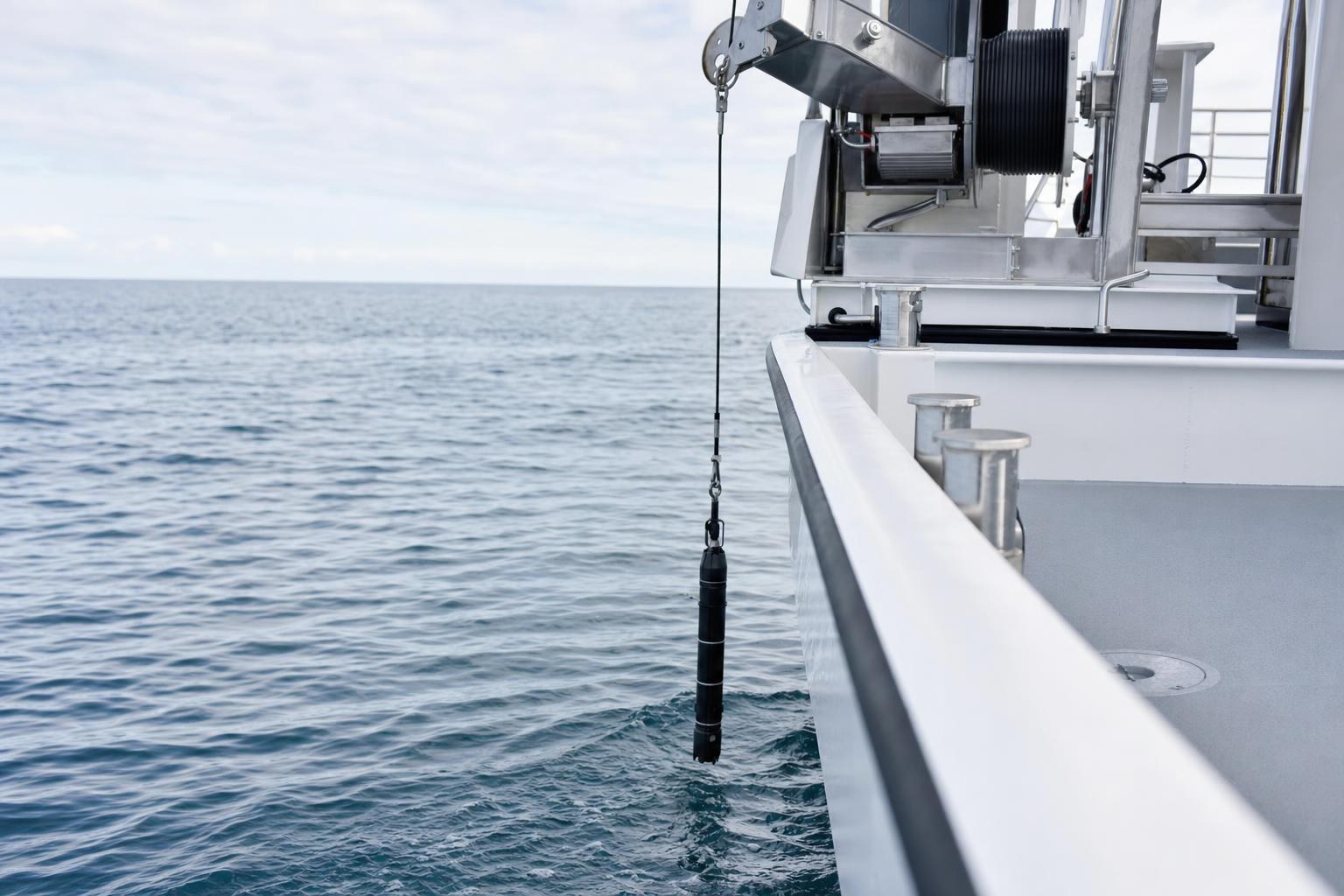
The array comprises bottom-moored and suspended hydrophones feeding low-noise pre-amplifiers, with the same continuous-recording and full-archival discipline applied to the antenna array. Sensor depth and spacing are chosen for long-range propagation in the deep sound channel, where a low-frequency source can be heard across an ocean basin.
| Parameter | Nominal value |
|---|---|
| Frequency range | ~1 Hz -- 2 kHz |
| Configuration | moored + suspended, low-noise |
| First deployed | 1960s |
| Rebuilt to current standard | 2011 |
| Recording | continuous, archived in full |
The oceanic record
Several of the most-studied anomalous detections in the public literature are oceanic: the ultra-low-frequency events recorded by monitoring hydrophone networks, and the persistent calls of the water column that resist a tidy explanation. The Laboratories maintain entries for the notable ones in the Persistent Signal Catalog, and contribute the array's own detections to the same record.
- Ultra-low-frequency transients of the deep sound channel
- Persistent biological calls at anomalous frequencies
- Coincident events recorded across separated instruments
- 1.NOAA / U.S. Navy hydroacoustic monitoring literature, on which several catalog entries draw.
- 2.FAL Technical Report 11-014, Rebuild of the hydrophone array to low-noise standard.